


APPLICATIONS
Mine Backfilling
Efficient, Safe and Sustainable Mining Solutions
Mine backfilling (paste backfill) is one of the most technically challenging applications in modern mining. The process of metal extraction involves the accumulation of large quantities of tailings, which can be used to backfill abandoned mines. With growing environmental awareness, the management of tailings from mining processes has become a critical issue for mining companies. As a byproduct, tailings have no real economic value and simultaneously pose risks to the environment. Consequently, their disposal presents a real challenge in the mining industry. The need for storage facilities is increasing due to the large volumes involved. There is a risk of tailings pond failure, and water contained in the tailings could harm the environment if it infiltrates.
Backfilling with Piston Diaphragm Pumps as an Economic Alternative
In this context, backfilling is a sensible solution to the costs, risks, and problems associated with tailings management. To achieve this, the water content of the tailings is reduced, creating a thickened (paste-like) product. This reduces the risk of contaminated water seeping into the environment and facilitates backfilling. The product is then pumped into mines that have already been used. In this context, reliable pump technology is particularly important, as it must meet the highest standards for durability, availability, and process reliability.
Pastefill Requirements for Pump Technology and Process Safety
Backfill paste is achieved by thickening mining tailings, which may be mixed with cement as a binding agent to achieve the required strength. The paste places extreme demands on the pump systems used – particularly with regard to:

Handling of high solids content
Low maintenance and long service life
Minimized risk of failure
High availability
Pump Solutions for Mine Backfilling
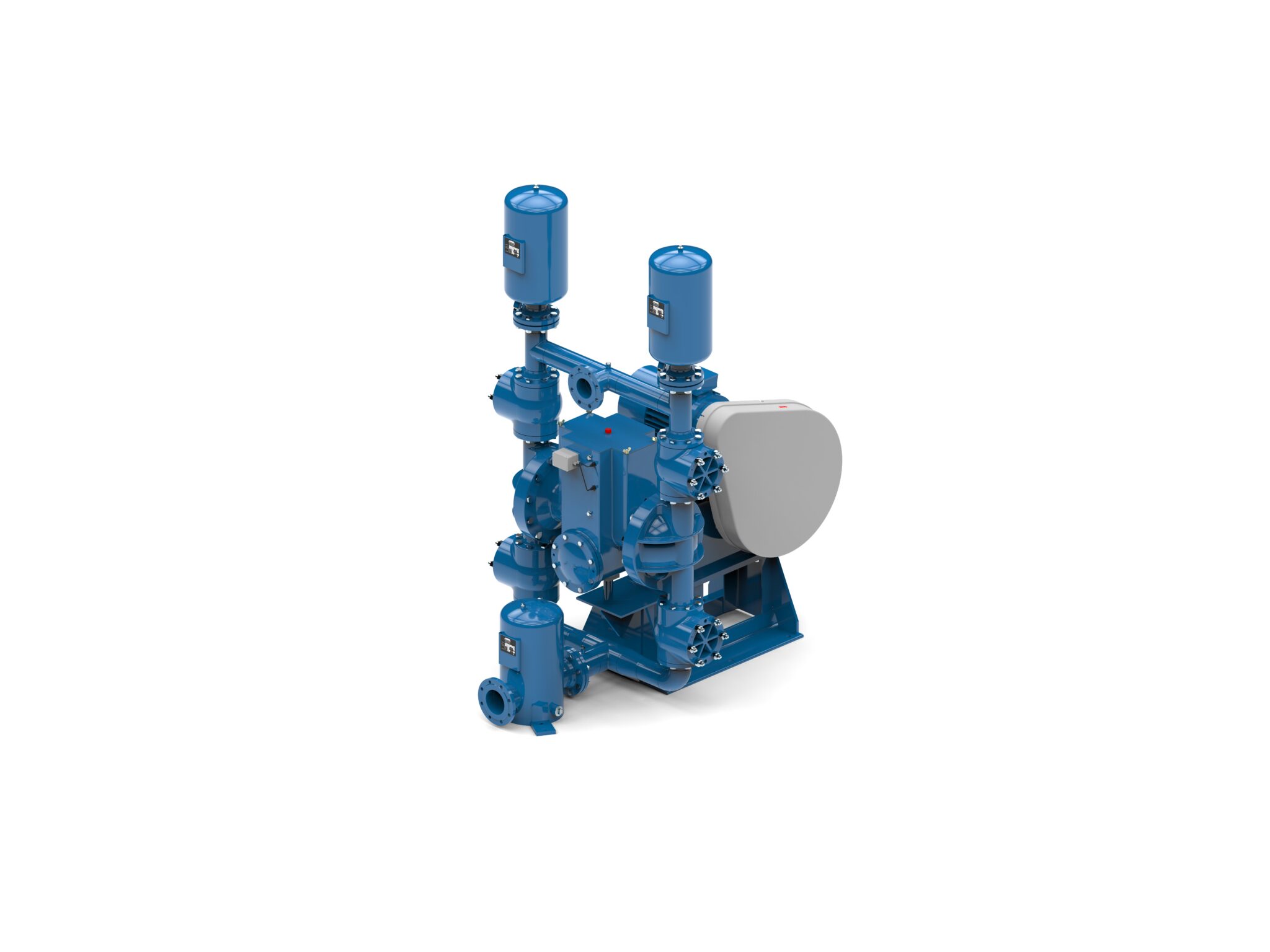
ABEL has developed a piston diaphragm pump from the HMQ series specifically for backfilling, which enables the safe transfer of cemented paste and paste-like tailings. Pumps used in these critical applications are also equipped with our AI pump monitoring system.
ABEL HMQ Piston Diaphragm Pump
The ABEL HMQ piston diaphragm pump was developed specifically for mine backfilling. An innovative design of the components that are in contact with the backfill paste reliably prevents cement from solidifying inside the pump.
Advantages of ABEL Pumps in Mine Backfilling
- Operation for more than 6 months without pump maintenance
- Resistant to abrasion
- Solid content can be up to 75 %
- Maximum process reliability in paste backfill applications
- High pump availability
- AI pump monitoring
- Predictive maintenance capability
ABEL - Maximum Pump Availability in Mine Backfilling
Pumps suitable for this application
AI Pump Monitoring to Prevent Unplanned Downtime
The monitoring system, Smart Pump Assistant, is an integral part of the HMQ piston diaphragm pump and enhances them with intelligent, AI-powered analytics for maximum efficiency and pump availability. All relevant operating parameters are recorded and analyzed using AI. This enables predictive maintenance. In practice, thanks to the Smart Pump Assistant, we achieve impressive process improvements for our customers in backfilling applications.
At our customer Salinen Austria in Austria, ABEL HMQ pumps have been used for backfilling for years. When the pump was replaced in 2021, the Smart Pump Assistant was also installed. The result: maintenance intervals doubled, reduced maintenance costs, and a sustainable increase in efficiency in mining operations.
Additional field results with the Smart Pump Assistant
At a Spanish mine backfilling facility, the use of the Smart Pump Assistant reduced maintenance time from 48 hours to 3 hours because AI monitoring provides detailed maintenance information and instructions.
The AI pump monitoring system, Smart Pump Assistant, is a major part of our piston diaphragm pumps and ensures stable processes. It prevents downtime during backfilling cycles, so that maintenance takes place exclusively between backfilling operations.

Request the Field Report
- Efficient mine backfilling: longer maintenance intervals thanks to AI pump monitoring
Please fill out the form. We will then send you the field report via email.